
-
Mail us
sale@tiger-transformer.com -
Phone us
(+86)15155183777 -


Mail us
sale@tiger-transformer.comPhone us
(+86)15155183777
The magnetic flux in the primary and secondary coils of the transformer is the same. But in fact, the transmission of magnetic field is accompanied by losses, which can be roughly divided into the following situations:
Eddy current loss
Hysteresis loss
Leakage Magnetic losses
1. Eddy Current Losses
Faraday said that changing magnetic fields can produce electricity. Lenz said that this electricity would hinder the change of the magnetic field, which is called back electromotive force (Back EMF).
The magnetic core of the transformer is in a changing magnetic field, and electricity is also generated on it, which appears as many small eddy currents. This phenomenon is called the eddy current effect (Eddy Current).
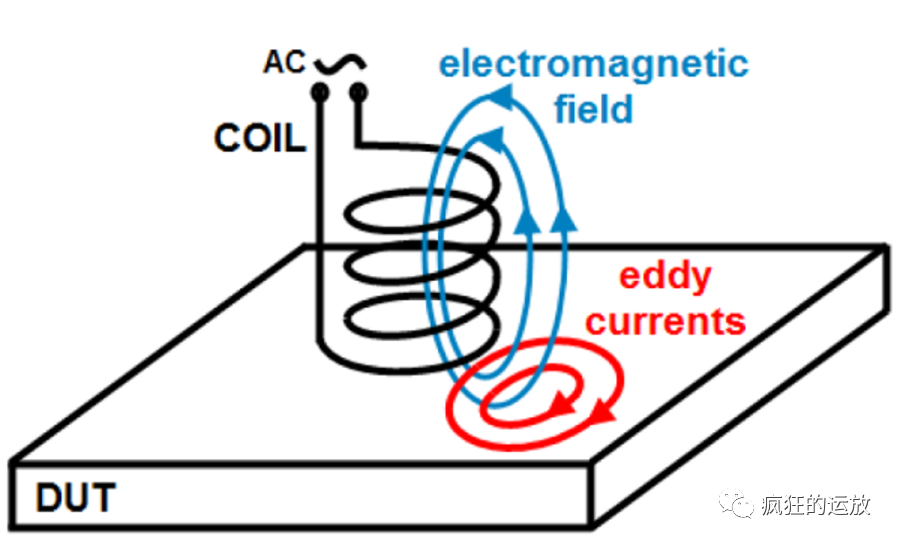
Figure 1-Eddy Current Phenomena (Eddy Current)< /p>
Eddy current is useful in some cases. For example, home appliance induction cookers heat food based on the principle of eddy current. But there will be losses in the transformer.
In order to solve the problem of eddy current, there are two ideas:
Decompose the large magnetic core into a large number of small magnetic cores, such as lamination, powder, etc.;< /li>
Use high resistivity materials, such as ferrite ceramics, silicon steel and other materials;
1. Lamination
For the "mouth"-shaped or "日"-shaped magnetic cores in the transformer, they are not a single cylinder, but are composed of many layers of magnetic chips. There is insulation isolation between the magnetic chips, which allows the eddy current to be generated only in a very narrow area (the area is perpendicular to the magnetic field). Since the size of the eddy current is proportional to the area, this can significantly reduce the eddy current. Moreover, the thinner the magnetic chip, the better the effect.
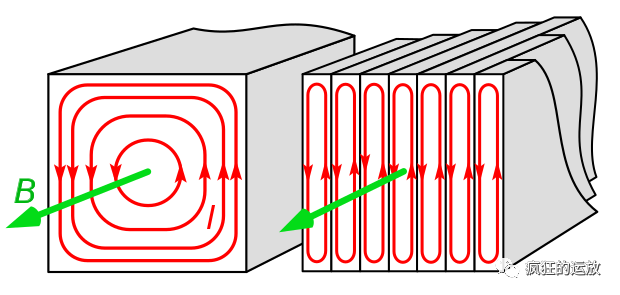
Figure 2-Transformer core unit (left) vs lamination (right), where B represents the magnetic field and red represents the eddy current
2. Ferrite (Ferrite)
Ferrite is a A ceramic material with iron oxide as its main component. Most ferrites are magnetic materials used to make permanent magnets (hard ferrite) and transformer (soft ferrite) cores. The high resistivity of ferrite itself can reduce eddy current phenomena.
`2. Hysteresis Losses
The so-called hysteresis means that the magnetization of matter not only depends on the external magnetic field "at that time", but Also dependent on the "before" magnetization results. That is, once magnetized, the magnetism will be retained. To demagnetize, a magnetic field in the opposite direction needs to be applied.
We can see clues from the BH curve:
The symbol B refers to magnetic flux density (Magnetic Flux Density), which is also translated as magnetic induction intensity in China. I think the former is more Accurate;
The symbol H refers to the magnetic field strength (Magnetizing Force), which is the magnetomotive force per unit length (mentioned previously), which can be understood as being proportional to the current passing through the coil;
< /ul>
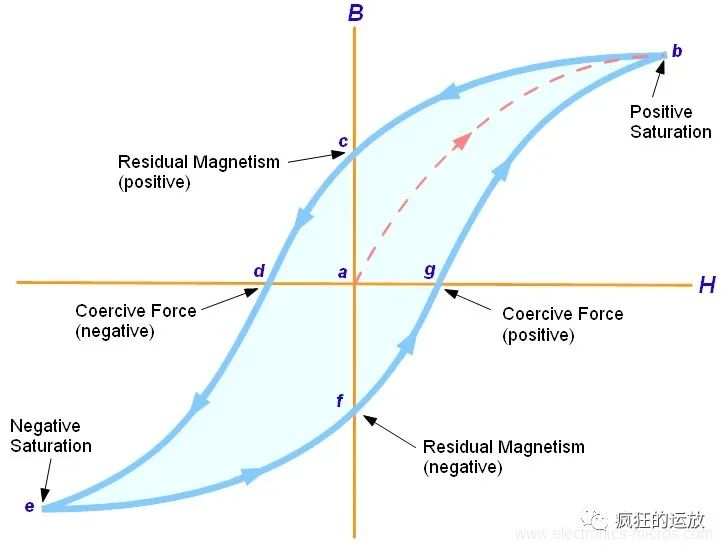
Figure 5-BH Curve
The evolution process is:
The origin of the coordinate axis (a) indicates that the material is not magnetized, and then a forward current is input to the coil (H axis is positive), the material shows magnetism, and the magnetic flux is Positive (red dotted line);
When the current increases to a certain level, the magnetic flux grows slowly and enters the magnetic saturation state (b);
If the current stops, the material can still show magnetism (c);
The magnetism will disappear only by applying a reverse current (d).
In the transformer, the magnetic core is repeatedly magnetized by alternating current. We hope that the hysteresis of the magnetic core is as small as possible, otherwise more energy will be wasted in overcoming the hysteresis.
The ferrite mentioned above is divided into two types: soft and hard. Soft ferrite is easier to be demagnetized, which means the narrower the shape in BH (the smaller the distance between d and g) :
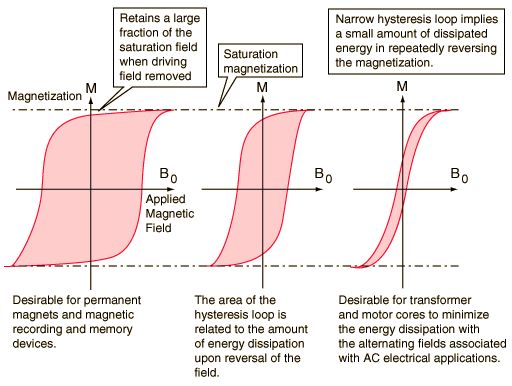
Figure 6 - Hard magnet (left) to soft Magnet (right)
3. Leakage Magnetic Flux
Although the magnetic core has high magnetic permeability, there are always some Magnetic fluxes do not travel along the core, they leak to the outside, called flux leakage.
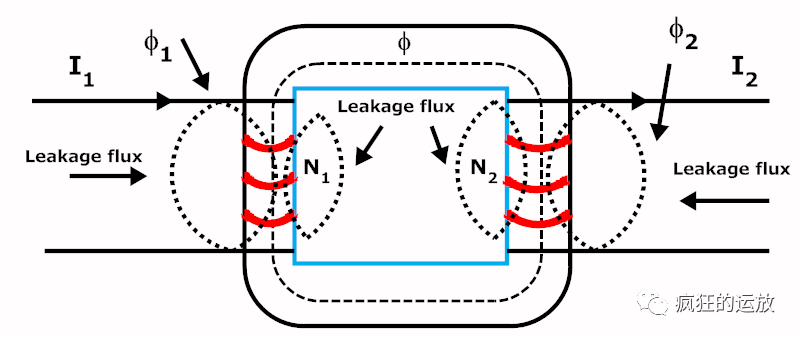
Figure 7-Leakage Flux
Magnetic leakage does not participate in the magnetic coupling energy transfer between the primary coil and the secondary coil. They are like inductors, connected in series in a circuit. As an impedance, the inductor will produce a voltage drop, so the actual voltage on the transformer will be smaller:
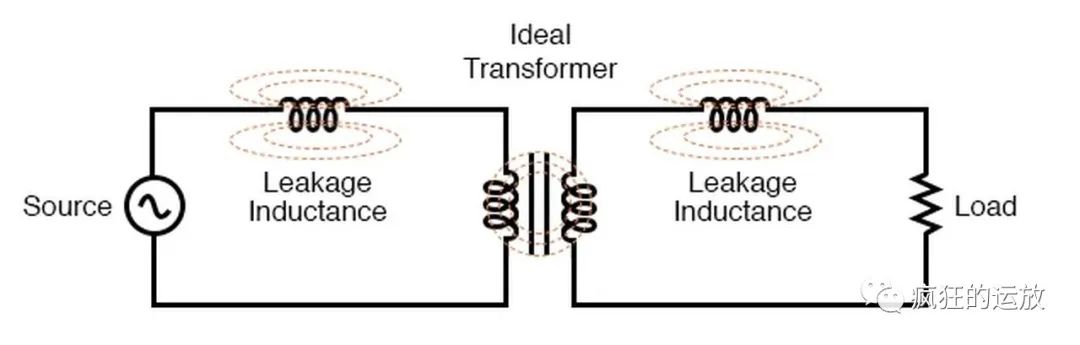
Figure 8 - Transformer equivalent circuit (simplified inductor in series)
In summary, we have explained the loss phenomenon on the transformer. When the secondary coil is open-circuited, a smaller current will pass through the primary coil. Part of this current is the magnetizing current (Magnetizing Current) mentioned above, and the other part is the current caused by the losses described in this article (Core Loss Current). The two The sum of them is called Exciting Current. `