
-
Mail us
sale@tiger-transformer.com -
Phone us
(+86)15155183777 -


Mail us
sale@tiger-transformer.comPhone us
(+86)15155183777
What are the effects of noise (or noise)? Is lower the better? Is the requirement of low noise very important? Regarding the noise problem of HIFI amplifiers, everyone may have different understandings. I will sort out this issue and hope to share and discuss it with you.
1. Some views on noise
Many friends think that low noise of HIFI amplifiers is very important, but some friends may not think so. First, let’s take a look at some of the following opinions:
1) When listening to music, I didn’t hear any noise, so there’s no problem;
2) The noise floor is too clean, It will feel unreal. Appropriate noise can increase the sense of presence;
3) Low noise will cause the details of the music to be overexpressed, affecting the sense of listening and concentration of music appreciation;
4) Low noise will expose The disadvantages of amplifiers affect the feeling of listening to music;
5) The impact of noise in musical works and the noise generated by amplifiers are the same;
6) Low noise can make the background clearer Quiet, but it will not change the musical expression of the work;
7) The signal-to-noise ratio index of the amplifier meets the requirements. No matter how low the noise is, it does not make much sense;
8) Too much pursuit of low noise will It leads to deviations in the concept of listening, excessive pursuit of parameters and deviation from art;
9) Sound masking effect, the music covers the noise and masks the noise. Louder noise will not affect music appreciation.
So, are these views correct?
2. Noise and sources
Let’s review noise and its main sources.
Noise has random and continuous characteristics. For some sudden and non-continuous signals (except for signals that need to be transmitted), they are sometimes called interference sounds. Here, we only discuss noise.
The picture below is a noise waveform diagram and a comparison with the AC sinusoidal signal waveform.
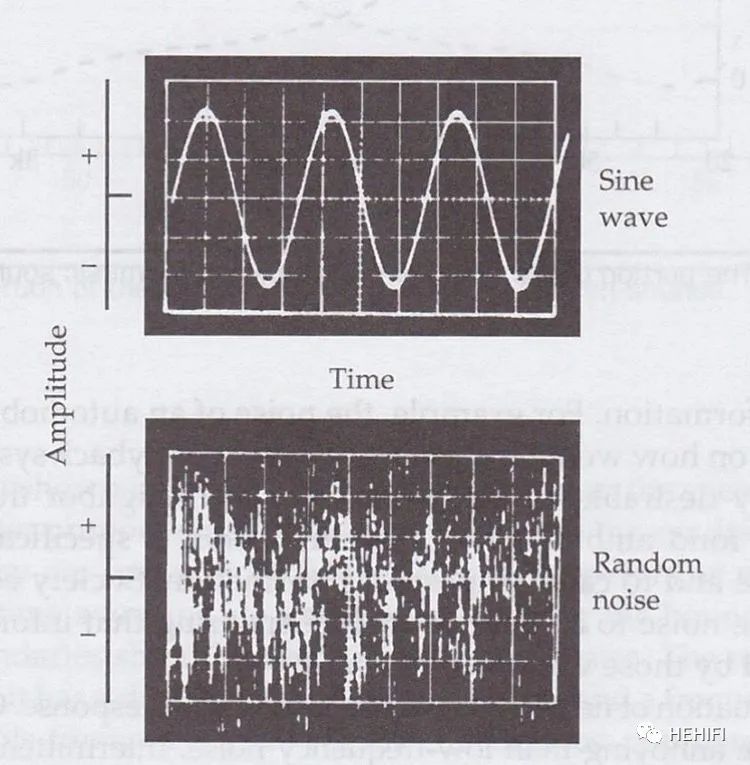
For HIFI amplifiers, noise is any or all other than the music and vocal signals you wish to transmit signal (except interference), where does this noise come from? The following are some possible ways:
1) Noise contained in musical works
Noise will be introduced into musical works during the recording and production process, such as background sounds in the recording studio, The sound of air conditioners, noise generated by equipment, etc.
2) Noise generated by amplifiers
There are many ways for amplifiers to receive and generate noise, and the mechanisms are also very complex. The main ones include noise from resistive components (Johnson noise) and semiconductor components. Noise, ripple sound generated by AC power supply (also called hum or hum), noise generated by various mixed signals transmitted from the power grid, noise generated by external radio wave interference or electromagnetic induction, the amplifier itself does not work properly Noise caused by stability (such as self-oscillation), noise caused by vibration of devices (such as transformers), etc. We will not discuss the effects of amplifier distortion here.
3) Noise transmitted from front-end equipment
Front-end equipment will also bring some noise, including noise generated by the output resistance of the front-end equipment and noise generated by the front-end equipment when amplifying and transmitting signals. , the interference sound received by the connecting line, the hum of the loop formed by the power supply and the ground, etc.
4) Noise generated by the environment
Noise generated by the surrounding environment where you listen, such as the sound of the air conditioner working, the sound of the computer fan, other sounds from the outside, etc.
3. Signal
We might as well call the audio signal of instrumental music or human voice that we hope to transmit and amplify as "signal" to distinguish it from the above-mentioned "noise" and "interference sound" . Let’s review the basic characteristics of signals.
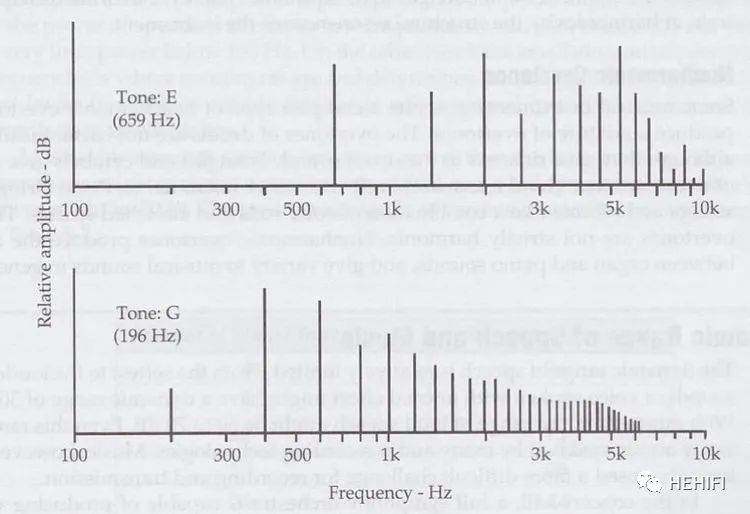
As you can see from the picture above, the violin strings emit E sounds (659Hz) ) and G sound (196Hz), in addition to the frequency of the fundamental wave, many harmonics (or overtones) are also emitted. In fact, the frequency range of the sound that the violin can produce (also the frequency of the fundamental wave) is 196 ~ 3136Hz, and the frequency range of its harmonics can be as high as 4 ~ 15kHz (Excerpted from: "Practical Recording Technology, Sixth Edition", Bruce Bartlett, Jenny Bartlett, translated by Zhu Wei).
This is an example of the violin, and the situation is similar for other musical instruments and human voices (the overtones of some special instruments such as drums, bells, pianos, etc. are not harmonics that are multiples of the fundamental frequency).
Two basic characteristics of sound
We can summarize the following conclusions:
1) The sound signal is composed of a fundamental wave and a wave of different sizes. It consists of many tiny harmonics (or overtones)
There are many harmonics and their amplitudes vary widely. They are generally much smaller than the amplitude of the fundamental wave. The trend is to gradually decrease as the order of the harmonics increases. Small, that is, the higher the harmonic frequency, the smaller its amplitude;
2) Harmonics (or overtones) reflect the characteristics and timbre of instrumental music or human voice
It is different The combination of harmonics is used to distinguish one instrument from another (such as a violin instead of a trumpet), or the same instrument but different timbres.
It should be noted that, for example, the same player playing different violins will have different timbres, and different players playing the same violin will also have different timbres. The reason is also because of harmonics. Something has changed.
4. The impact of noise on sound
How does noise affect sound? The most intuitive situation is as shown in the figure below. The signal changes after adding noise.
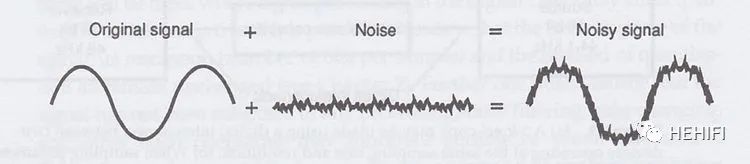
This is a situation that everyone is familiar with. It is obvious that the signal is contaminated by noise. How serious is the problem? It may not explain anything, so let’s do some analysis.
1. From the spectrum
First look at the following picture:
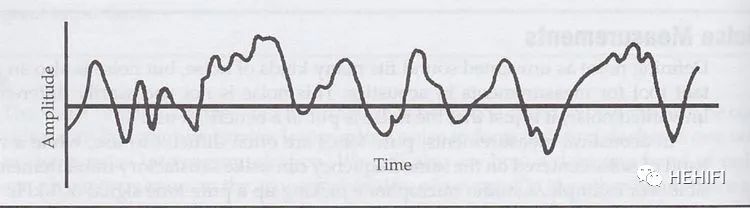
The waveform of noise seems to have no clear regularity, and it is difficult to use theoretical (mathematical) tools to quantitatively analyze it. In order to make qualitative analysis, we make some approximate assumptions, especially in When the noise contains hum (hum is periodic), we assume that the waveform of the noise is a periodic non-sinusoidal wave, or a combination of periodic non-sinusoidal waves. In this way, the theory of Fourier series can be used for further analysis.
The Fourier series means that any periodic non-sinusoidal wave can be decomposed into the sum of a series of sinusoidal quantities of different frequencies.
Then, any noise can also be decomposed and viewed as a combination of many sine waves of different frequencies, just like the sound of the violin above. The figure below is an example of a noise spectrum.
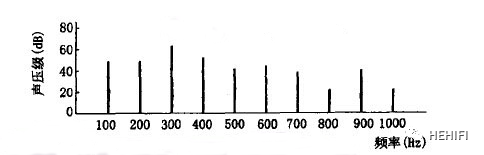
Take the violin above as an example. By superimposing the violin’s spectrogram and the noise spectrogram together, you will get another new spectrogram, which is a different spectrum that has been changed. picture. According to the analysis of the two basic characteristics of sound above, the sound characteristics and timbre of the violin will change.
This is the case with the violin, and other sounds are the same or similar.
But there is a premise that the spectrum amplitude of the noise is meaningful relative to the amplitude of the signal, that is, the amplitude of the noise cannot be ignored.
2. From the perspective of amplitude
Let’s look at how noise affects sound from the perspective of amplitude.
1) Signal-to-noise ratio
Signal-to-noise ratio is a performance indicator measured by amplitude. Simply put, it is the output voltage under the rated input and output conditions of the amplifier (generally The ratio of the maximum undistorted output voltage) and the output voltage when the input electromotive force is zero (that is, the noise voltage) is then calculated. The formula is:
Signal-to-noise ratio = 20Log (maximum undistorted output voltage/noise voltage), unit is decibel (dB)
According to the national standard "GB/T 14200-93 high fidelity "Minimum Performance Requirements for Audio Amplifiers" stipulates that the minimum requirements for signal-to-noise ratio (unweighted) are: 58dB for preamplifiers and combined amplifiers, and 81dB for post-amplifiers.
Here, when measuring the signal-to-noise ratio, there are the following situations:
a. The amplifier works in the state of maximum undistorted output
This is the amplifier limited by distortion (the distortion index complies with the standard or the data provided by the manufacturer, and no clipping occurs), that is, the volume potentiometer knob is turned clockwise to the maximum position that does not cause distortion;
b. Input The electromotive force of the signal is the rated value (when measuring the maximum output voltage)
In accordance with the requirements of the national standard "GB/T14197-2012 Preferred matching values for interconnection of audio, video and audio-visual systems", the power amplifier connected The minimum source electromotive force of the input signal is not less than 1V. The national standard "GB/T 14200-93 Minimum Performance Requirements for High-Fidelity Audio Amplifiers" stipulates that the overload source electromotive force of the power amplifier is not less than 2V. Basically, the value of the source electromotive force can be approximately regarded as the value of the signal voltage. That is to say, the rated input signal voltage must be greater than 1V. How much greater it can be depends on the input overload capability of the amplifier, which generally must be able to withstand it. 2V input signal voltage. In fact, the analog output voltage of a general CD player is 2V effective value (RMS), and some decoders output a higher voltage of 4V effective value (RMS).
c. The frequency of the input signal is a single frequency.
The measurement of signal-to-noise ratio does not require the input signal to simulate an actual music signal, that is, a combination of fundamental and harmonics. , and generally a sine wave with a specified frequency of 1KHz is used as the measurement input signal.
2) If the signal-to-noise ratio reaches the standard, is there no problem?
The signal-to-noise ratio reflects the performance level of the amplifier, but it still cannot prevent the following situations from occurring:
a. Not working at the maximum output position
and when measuring The difference is that in reality, no one (or almost no one) listens to music at maximum output. Instead, they often enjoy music at a working position close to the minimum (sometimes attenuated). When the working state changes to a smaller direction, the output voltage corresponding to the signal decreases accordingly. Because the noise is comprehensively generated by the entire circuit of the amplifier, the noise will not decrease at the same ratio (especially when the AC hum is in the noise When the sound is dominant, the hum will often not decrease as the volume decreases, but sometimes it will increase).
Therefore, under actual working conditions (in most cases), the signal-to-noise ratio performance of the amplifier cannot be guaranteed.
b. Do not work at a volume level of zero.
Similarly, in reality, no one listens to music at a volume level of zero. That is to say, the input signal must be amplified (sometimes attenuated) to a certain extent (it is generally considered that 85dB sound pressure level is more suitable for listening to music), so that the noise at the input end is also amplified (or transmitted) to a certain extent.
c. The input signal is not of a single frequency and the amplitude is not the rated value.
In reality, there is no way to ensure that all input signals can be maintained at the rated value, especially as mentioned above. Audio signals contain many harmonics (or overtones). So, the question is, can we determine how small a weak audio signal or harmonic will be? Probably not.
In this way, what will be the result of adding a certain degree of noise and a tiny signal or harmonic (or overtone) that is not sure how small (although it is also amplified)? The sound changes when some parts of the sound signal are altered or drowned out by noise.
The table below can be further explained. As shown in the table, in a band, the difference in strength (or signal amplitude) of different sounds is huge.
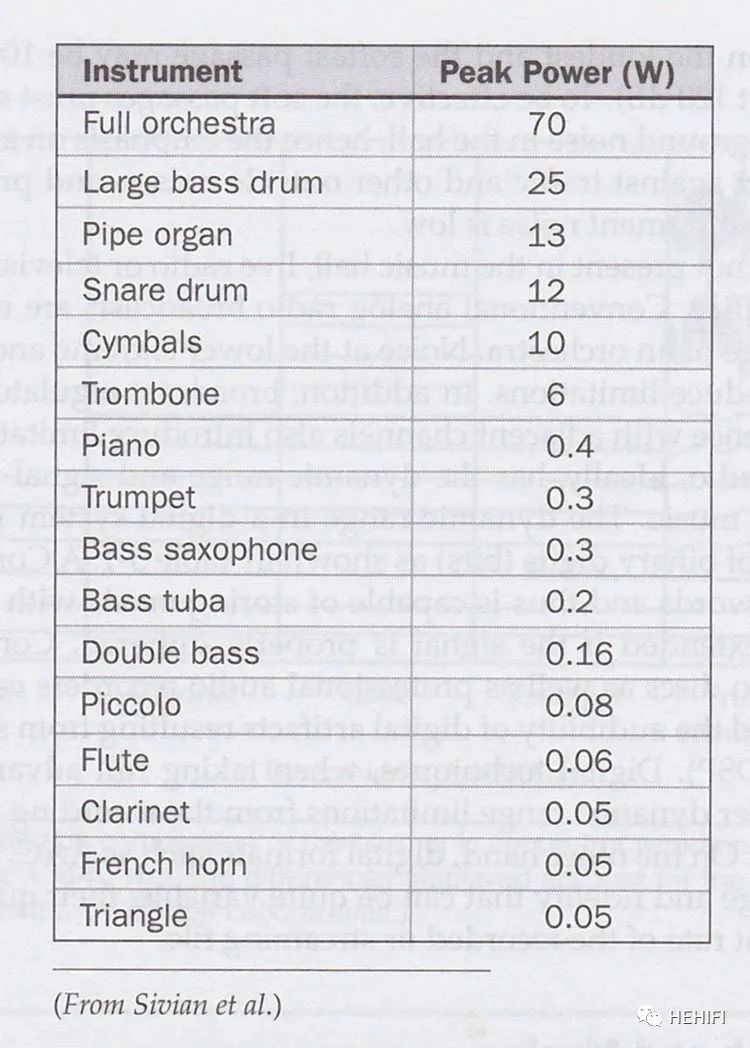
We might as well calculate that according to the rated input signal voltage of 2V effective value corresponding to the 70W band as a whole, the input signal voltage corresponding to the maximum peak value of the minimum power instrument is only 53mV effective value. At this time, the signal-to-noise ratio has dropped by 31dB, and the minimum performance indicators required by the previous national standards have actually dropped to 27dB and 50dB respectively. If you calculate the values in actual use (non-maximum peak value, non-maximum output state) and then consider the impact on harmonics, the actual signal-to-noise ratio will be reduced even more. It can be seen that in music signals, the useful signal amplitude can be very small (can be as low as the sound pressure level of the auditory threshold), and the actual signal-to-noise ratio can also be very low.
5. Under what circumstances can the impact of noise be ignored?
In both cases, the impact of noise should be negligible.
1) The absolute sound pressure level of the noise (after amplification) is below the auditory threshold; or
2) According to the 1/3 principle, the amplitude of the noise is greater than that of the same frequency. The amplitude of the signal is more than 2/3 smaller. In other words, the amplitude at each frequency of the noise spectrum is more than 2/3 smaller than the amplitude at the same (or similar) frequency in the signal spectrum, and no new harmonics appear.
However, no matter what the situation is, the conditions to be met are very demanding.
6. Conclusion
Through the above analysis, noise has a great impact on sound. Is this impact always harmful, or can it sometimes be beneficial?
For noise in musical works, the sound engineer may allow or add some noise from an artistic point of view as part of the artistic creation.
For amplifiers, noise can only change or drown out some details in the musical work, making the replayed work no longer realistic. These details are exactly indispensable for HIFI amplifiers, especially high-end HIFI (these details are important elements to confirm whether it is high-end HIFI).