-
Mail us
sale@tiger-transformer.com -
Phone us
(+86)15155183777 -


Mail us
sale@tiger-transformer.comPhone us
(+86)15155183777
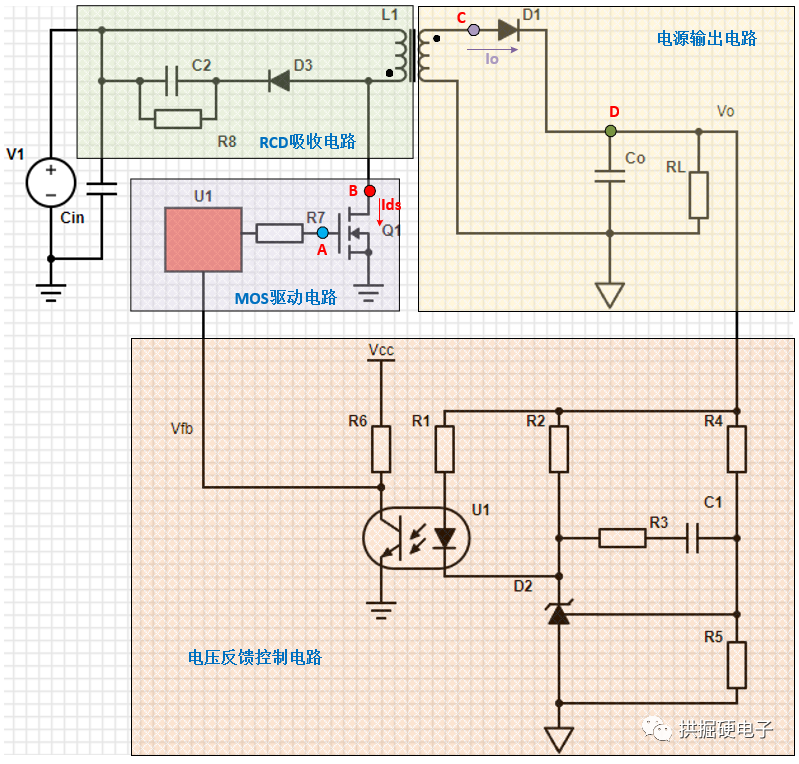
Type of output diode
Secondary winding output diode D1 usually chooses a Schottky diode or an ultra-fast recovery diode, one is because the reverse recovery time trr of these two diodes is short, and the other is because the forward voltage Vf drop of these two diodes is small.
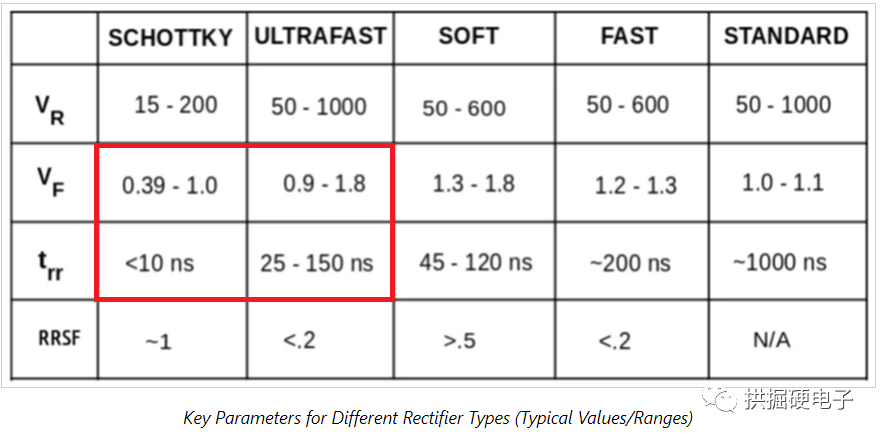
If the diode reverse recovery time trr is too long, it means When a reverse voltage is suddenly applied across the diode, it takes a long time to change from the on state to the off state. In the process of state transition, reverse voltage and reverse current exist at the same time, and the time is very long, which means that a large diode switching loss will occur in one switching cycle. In flyback power supply applications, the higher the switching frequency and the higher the switching loss of the output diode, the higher the diode temperature and the lower the power supply efficiency. It shows that diodes with a long reverse recovery time (above 100ns) are not suitable for high-frequency switching (100kHz level) flyback power supplies.
Moreover, too long reverse recovery time will affect the normal operation of the high-frequency switch of the flyback power supply. If there is a flyback switching power supply with a switching frequency of 200kHz and a PWM control pulse duty cycle of 50%, then the switching cycle is 5us, which is equivalent to setting the output diode to cut off half of the time (2.5us) in one cycle, half of the time ( 2.5us) conduction. Assuming that the output diode in this flyback power supply uses Diotec's ordinary diode 1N4007, according to its data sheet, its typical reverse recovery time is 1.5us, which means that the output diode is on for 80% of the time, and in one cycle The turn-on time is 4us (that is, 2.5us+1.5us), which is very different from the turn-on and turn-off time of the output diode set by design, which makes the output voltage abnormal. If the switching frequency of the flyback power supply is higher, the ordinary diode is too late to cut off, which is equivalent to being on all the time, and the function of the reverse cutoff of the diode is completely lost.
On the other hand, the conduction power of the diode P=If×Vf, where If is the forward conduction current, and Vf is the forward conduction voltage drop. It can be seen that when the output current Io is constant, the diode forward conduction current If=output current Io, the smaller the diode forward conduction voltage drop Vf, the smaller the conduction power of the diode, that is to say, the smaller the loss of the diode.
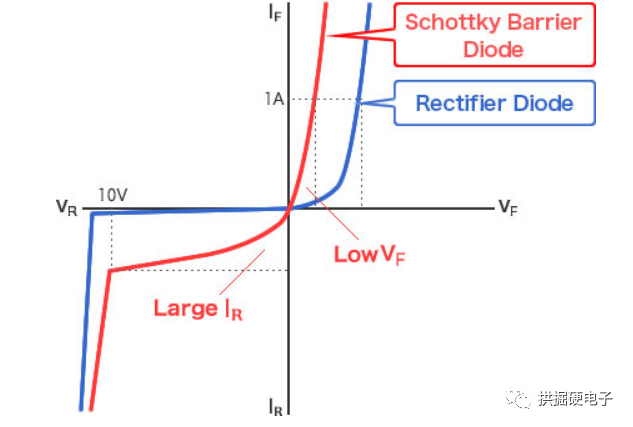
In general, the switching frequency of the flyback power supply is high , so the output diode should be an ultra-fast recovery diode or a Schottky diode, which can prevent the reverse recovery time from affecting the normal conduction or cut-off action of the output diode, and the lower forward conduction voltage drop is also conducive to improving the efficiency of the power supply .
Reverse recovery of the diode
The so-called reverse recovery of the diode refers to the process in which the diode is loaded with a reverse voltage in the conduction state and the diode returns to the complete cut-off state. This is the characteristic of the diode itself. As for the formation mechanism of reverse recovery, I don't think it is necessary to delve into it from the perspective of application.
The figure below compares the reverse recovery current curves of Schottky diodes and rectifier diodes. In the figure, I also added the direction of the diode loading voltage and the magnitude and direction of the current. if indicates the forward conduction current of the diode, and ir Indicates the reverse conduction current of the diode. During the entire reverse recovery process, as shown in the figure, the diode is loaded with a forward voltage at the initial moment, and the diode is forward-conducting current. From the second moment, the diode is loaded with a reverse voltage, and the forward current of the diode quickly drops to 0, and the diode conducts reversely. The current first increases and then decreases until the diode is completely cut off, that is, the diode current is 0. The length of time from when the forward current is 0 to when the reverse current reaches the maximum value of the reverse current × 0.25 for the second time is called the diode reverse recovery time trr.
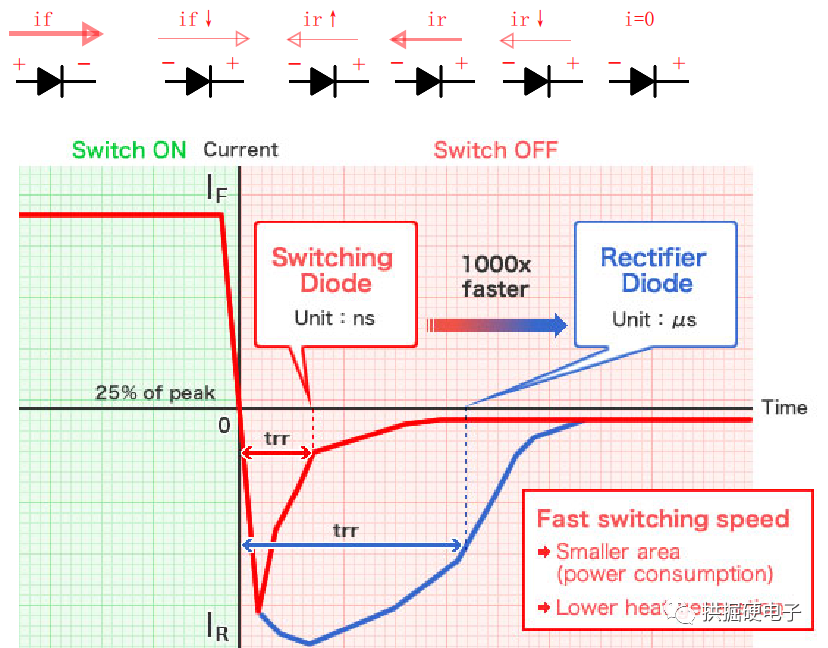
From the picture above, we can also see that Short The reverse recovery time of the base diode is much shorter than that of the rectifier diode. The shape enclosed by the reverse recovery current curve and the time axis is approximately rectangular. The reverse recovery loss is W=Vr×IR×trr, where Vr is the diode Reverse voltage, IR is the maximum reverse current, trr is the reverse recovery time. Therefore, the reverse recovery loss of the Schottky diode is lower and the heat generated is smaller.
Reverse withstand voltage of the diode
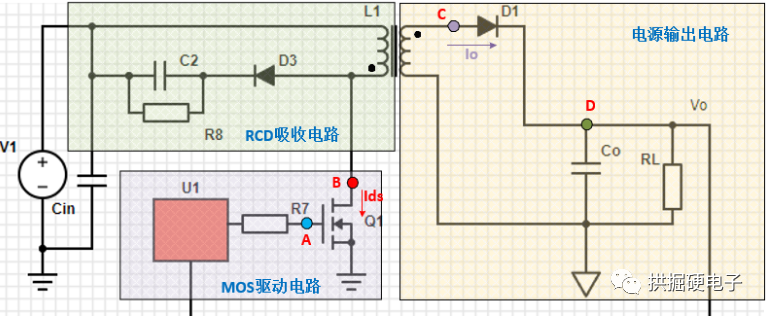
When the MOS tube is turned on, the induced voltage of the primary winding of the transformer is positive at the top and negative at the bottom, and the induced voltage of the secondary winding is negative at the top and positive at the bottom, and the output The diode D1 bears the reverse withstand voltage at this time. The anode voltage of diode D1 is Vo, and the cathode voltage is -Vin/n, where Vin is the input voltage, and n is the turns ratio of the primary winding to the secondary winding. Then the reverse withstand voltage Vr=Vo+Vin/n actually borne by the diode, in order to find the maximum value of Vr,
Then the output voltage Vo and input voltage Vin should take the maximum value during calculation.
In practical application, it is necessary to reserve a certain margin. When selecting the diode, the recommended value of reverse withstand voltage VR is greater than 1.4 times Vr.
Diode current derating
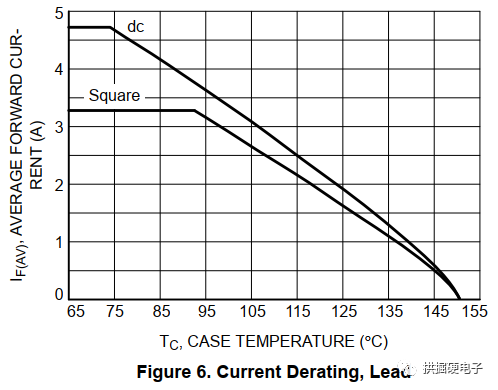
According to the output power and output voltage of the flyback power supply, the output current can be calculated. When selecting the output diode, it is considered that the forward conduction current capability of the diode will decrease at high temperature, so the output current can be 3~5 times to select the output diode.