
-
Mail us
sale@tiger-transformer.com -
Phone us
(+86)15155183777 -


Mail us
sale@tiger-transformer.comPhone us
(+86)15155183777
The stator winding of the motor is the part that generates the rotating magnetic field, and its failure will directly affect the normal operation of the motor. Common faults of stator windings are as follows:
1. Moisture
In the motor storage location or workplace, if the humidity is high, the motor may be damp. When the motor is stored in a place with high humidity for a long time or out of service for a long time, the insulation resistance of the motor should be measured with a megohmmeter before use. If the low-voltage motor is less than 0.5MΩ and the high-voltage motor is less than 1MΩ/kV, it is considered that the motor winding has been damp and needs to be dried.
When drying, the temperature should be gradually increased, and the general heating rate should not exceed 20-30°C/hour. If the temperature rises too fast, the moisture on the surface of the winding will evaporate quickly, causing the moisture to diffuse from the surface to the inside of the winding, and the moisture inside the winding will not be easily discharged.
Keep the drying temperature at around 110°C, and pay attention to changing the air in the drying room that contains more moisture in time. When the winding insulation resistance value is greater than 10MΩ, and its value is basically stable within 3 hours, and the change is not more than 10%, it can be considered that the drying is completed.
For motors whose insulation has begun to age, consider re-dipping the insulating varnish when drying to increase the insulation strength.
Second, grounding
When the insulation resistance of the motor has dropped to zero or close to zero, after drying, the insulation resistance still does not come up, The stator winding can be considered to be grounded. To deal with the grounding fault of the stator winding, it is necessary to find out the grounding part. First, the motor wiring connection plate should be opened, and then the insulation resistance should be measured with a megohmmeter to find out which phase is grounded.
1. Smoke method
Add a voltage regulator between the stator core of the motor and the grounding winding, and use the voltage regulator to slowly increase Voltage, pay attention to the current can not be too large, so that the ground point heat and smoke, in order to find the ground point.
2. Magnetic needle method
 < /p>
< /p>
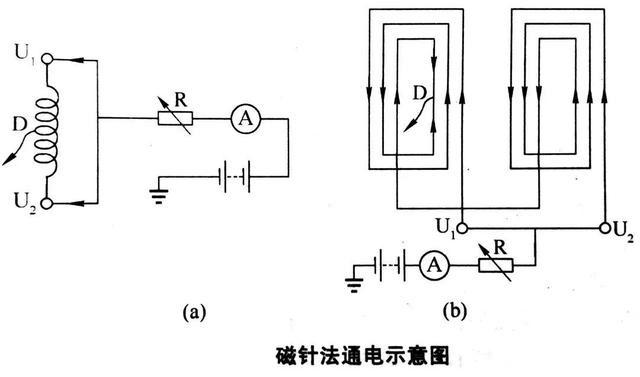
As shown in the figure above, short-circuit the two heads of the faulty one-phase winding and pass in DC current, and use a small magnetic needle to move in the notch of the winding under test. If the deflection direction of the small magnetic needle suddenly changes or deflects somewhere A sudden change in amplitude is usually the ground fault point.
For the motor whose windings are re-inserted, if there is a grounding phenomenon, it is often the reason why the insulation of the notch is damaged. Pad it well.
Third, short circuit
Due to excessive current, damaged wire insulation, or poor quality of insulating varnish, the winding is short-circuited, resulting in three-phase winding Asymmetry, the air gap magnetic field is uneven, the motor will vibrate, make noise, and even generate heat and smoke when it is running. Practical experience has proved that winding short circuits are mostly inter-turn short circuits.
1. Inspection method
1) Appearance inspection
Idle the motor for a few minutes, cut off the power and stop the motor immediately. Open the end cover, take out the rotor, touch the end of the winding with your hands, and feel which coil has a higher temperature, or which coil has a darker color, then it is considered that this coil is faulty.
2) Use a short-circuit detector to check inter-turn short circuit
The short-circuit detector is a transformer with an open core, and the part in contact with the stator core is made into the same arc as it shape, the width is also made the same as the stator pitch. As shown below:
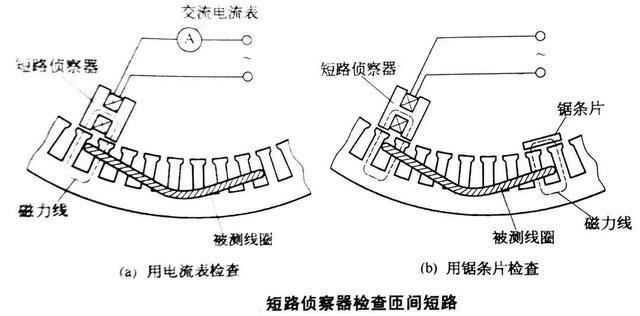
(1) As shown in (a) above Align the opening of the short-circuit detector with the slot of the stator, connect an AC ammeter to the coil of the detector, and pass a low-voltage AC current through a voltage regulator. If there is no inter-turn short circuit in the coil where the scout is located, a transformer similar to no-load operation will be formed, and the current value indicated by the ammeter will not be very large; if there is an inter-turn short circuit fault in the coil where the scout is located, then A transformer similar to a secondary short circuit is formed, and the ammeter will display a larger current value at this time.
(2) Another commonly used method is: use a voltage regulator to pass a low-voltage AC current in the coil of the short-circuit detector, and then use a hacksaw blade with a thickness of about 0.6mm to place the measured Another notch for the coil, as shown in (b) above, if the coil has a short circuit fault, this piece of hacksaw blade will vibrate.
It should be noted that for multi-channel parallel windings, each parallel branch must be opened before the short circuit detector can be used for measurement.
3) Current symmetry method
Use a voltage regulator to connect the low-voltage three-phase power supply to the three-phase winding of the motor, and measure the current of each phase separately. One phase of inter-turn short circuit fault.
2. Treatment method
1) Isolation
Usually, the common parts of short circuit are in the same pole and phase, two adjacent Coils and the outer part of the slot between the coils of the upper and lower layers, etc. If the faulty part is visible, you can use a scribe to remove the faulty part, put insulating material in the middle, tie it tightly and apply insulating paint.
2) Change the wire
If the short circuit is serious, you can remove this coil. The method is to heat the motor to 80-100°C to soften the insulating material. Then cut off the ends of this coil, pull the wire out with pliers, and replace with new slot insulation and coil.
3) Jump
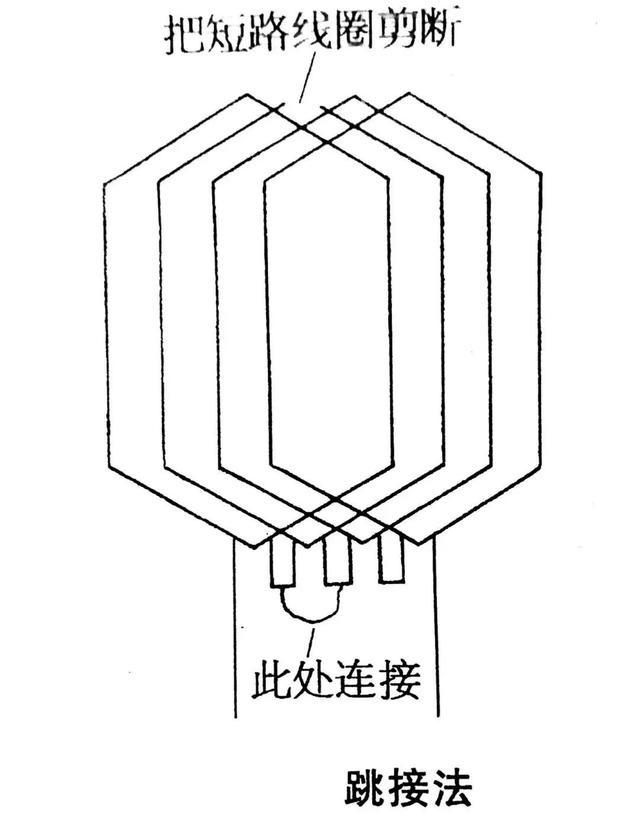
As above As shown in the figure, jump over the faulty coil and cut off one end of the faulty coil. It is enough to wrap the broken end with insulating material, but this treatment method will destroy the balance of the winding and reduce the operating performance of the motor.
Fourth, open circuit
The internal disconnection of the motor winding, or the joints of the lead wires are not welded firmly, etc., may cause the motor winding to be disconnected. Open circuit inspection can use a multimeter to measure several lead wires of the winding to find out the open circuit winding. Once the location of the break is found, measures can be taken. If it is broken outside the motor slot, solder the broken part with solder; if it is broken in the slot, you can jump the short-circuited coil by using the jumper method in the above figure.