
-
Mail us
sale@tiger-transformer.com -
Phone us
(+86)15155183777 -


Mail us
sale@tiger-transformer.comPhone us
(+86)15155183777
A typical data center power supply system consists of medium voltage power distribution, transformers, low voltage power distribution, uninterruptible power supply, terminal power distribution and generators and other equipment . Among them, the main function of UPS is to ensure the continuous power supply of the load before the mains power supply is interrupted and the generator is started. The UPS system is an important guarantee for the continuity of power supply in the data center. The reliability of the UPS system directly affects the reliability of the data center. At the same time, in most data centers, the loss of the UPS system can account for more than 10% of the energy consumption of IT equipment. Understanding ups is an important part of computer room construction.
This article will learn more about the four common problems of UPS: Among them, we often see brands such as Santak, Emerson, Kehua, and Kstar in projects. Of course, in addition to the above brands, Power Source, Renda, Baoxing, etc. are also good, and you can choose to use them according to the actual situation in the actual project.
Second, ups configuration calculation
For the formula calculation of ups, as we mentioned before, it is more complicated to calculate, and many people do not understand it , so today we come to understand the simple calculation method.
Calculate according to the following formula:
Required battery capacity (Ah) = UPS capacity (KVA )×109 (Ah. block)/KVA/Number of battery blocks per group
Example 1:
For example: for 109Ah•Block/kVADesign the algorithm of UPS battery capacity, a 120kVA UPS, 32 batteries per set, requires a backup time of 60min (ie 1h).
The required battery capacity is (60min):
120kVA×109Ah • block/kVA=13080Ah • block,
13080Ah • block /32pcs=409(Ah),
You can choose 12V, 100Ah batteries4 groups (32pcs/group).
Note: The actual backup time is less than 60 minutes.
If there are 33 batteries in each group, then 13080/33=396Ah, you can also choose 4 groups of 12V, 100Ah batteries (33 pieces/group).
Note: The actual backup time of 33 blocks/group is more than 60min (exceeding a little).
If the required backup time is 30 minutes:
Then
109×120=13080Ah blocks
13080/32=409Ah,
409/2=205Ah.
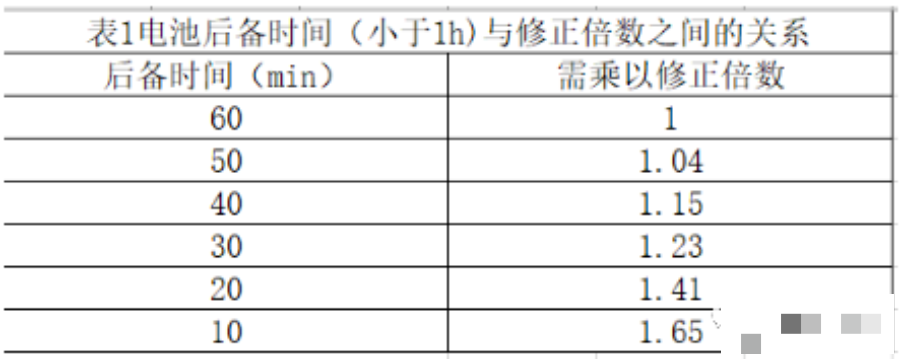
Because the discharge power and discharge time of the battery are not linear, that is, cannot simply divide by 2, but also need to be multiplied by a correction factor. See Table 1 below, so 205×1.23=252Ah. You can choose 4 sets of 12V, 65Ah batteries (32 pieces/set).
Note: The actual backup time is more than 30 minutes (more than a little).
< strong>If the backup time is required to be 20 minutes:
Then 409/3=136Ah, it needs to be multiplied by the correction coefficient, see Table 1, 136×1.41=192Ah, that is 3 groups of 12V, 65Ah batteries are optional (32 pieces/group).
Note: The actual backup time is more than 20 minutes (more than a little).
Other cases, and so on.
Example 2:
For the algorithm of 126Ah·block/kVA battery capacity, A 120kVA UPS, 32 batteries per set,
If the calculation time is more than one hour, it should be calculated according to the above and then divided by a correction factor, see the table below.
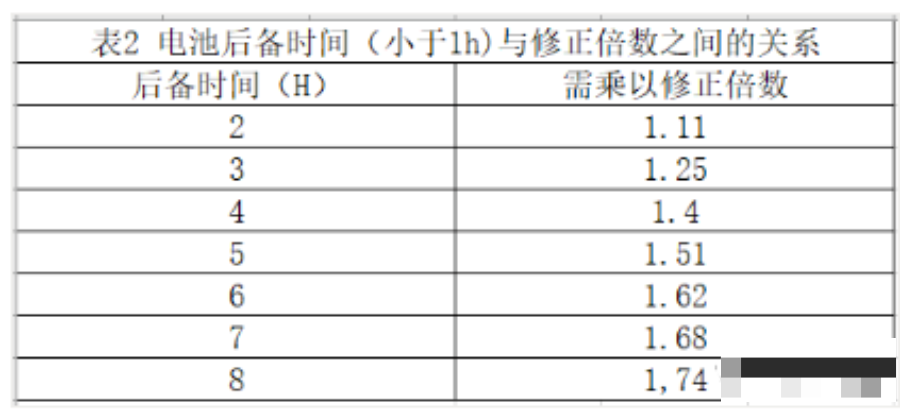
Calculate The method and the correction factor to be multiplied are exactly the same as above.
For example:
The backup time of the previous example is 3h:
then 126×120=15120Ah • block,
13080/32=472Ah,
472×3=1417Ah;
need to divide a correction factor, 1417/1.25= 1131Ah.
You need to configure 4 sets of 12V, 300Ah batteries (32 pieces/set).
According to the principle of energy conservation, the above method is the same for three-phase/single-phase or single-phase/single-phase UPS.
Generally, the UPS with medium and high power is equipped with 32 batteries for each group; it is better to connect the batteries in parallel not more than 4 groups, so as not to affect the battery Group current sharing and charging effect.
These are quick estimates and not particularly precise. But it can be used as a reference. If you want to get accurate results, you should refer to the battery discharge characteristics given by the battery manufacturer.
Third, how to install UPS
The installation sequence is as follows:
1. First determine the installation locations of the UPS and battery cabinets on site.
2. Install the battery cable.
A. Determine the position of the battery switch, determine the positive and negative directions of the battery in the battery cabinet, and install the air switch and on the battery cabinet Terminal block.
B. Start to connect the battery wire, connect the positive pole of the battery to the air switch.
C. The battery wires from the lower layer to the upper layer should be wrapped with tape to prevent accidental short circuit, and check the tightening of the bolts.
D. The positive and negative poles left at the end are clearly distinguished to prevent wrong connection. The positive pole is connected to the connection terminal from the air switch, and the negative pole is directly connected to the negative terminal of the battery. on the terminal block.
E. Check Is there anything irrelevant in the battery cabinet.
F. Before connecting the battery cable from the battery cabinet to the host, use a multimeter to measure the voltage of the battery, and check whether the positive and negative outgoing lines are reversely connected.
3. Installation and wiring of the main unit
A. Correctly connect the input and output of the UPS and the battery connection between the battery cabinet and the main unit.
B. Use a multimeter to measure whether there is a short circuit on the connecting wires on the terminal block of the host.
C. Disconnect the mains input, output, and battery switches on the host, respectively close the input switch of the power distribution cabinet and the battery switch on the battery cabinet, and measure whether the voltage is abnormal.
4. Startup of the main unit
After all the above steps are confirmed to be normal, follow the startup process steps to start up, convert the mains power and battery, and measure the output Whether the voltage is abnormal
5. Connect the load to see if the load is normal
After the UPS and equipment are installed, power on and start debugging.
Fourth, six commonly used UPS troubleshooting
1. When the mains power is available, the UPS has a mains power failure alarm
Possible reasons:
Mains input circuit breaker tripped;
Poor contact of input AC line;
Mains input voltage is too high High, too low or abnormal frequency;
UPS input circuit breaker or switch is damaged or fuseblown;
UPS internal market Electrical detection circuit failure.
How to deal with it
Check the input space. Check the input line;
If the mains is abnormal, do not deal with it or start the generator to supply power;
Replace the damaged circuit breaker, switch or fuse;
Check the UPS city Electrical detection circuit.
2. When the utility power is normal, the UPS output is normal; after the utility power is cut off, the load is also cut off.
Possible reasons
< p>Because the mains is often low voltage, the battery is undervoltage;
The UPS charger is damaged and the battery cannot be charged;
The battery is aging and damaged;
Load Overload, UPS bypass output;
The load is not connected to the UPS output;
The battery pack of the long-time delay model is not connected or is in poor contact;
UPS The inverter does not start (the control switch on the UPS panel is not turned on), and the load is supplied by the mains bypass;
The inverter is damaged, and the UPS bypasses the output.
Treatment method
Fully charge the battery when the mains voltage is normal; start the generator to charge the battery; add a voltage stabilizer to the UPS input;
Check the charger. Replace battery;
Reduce load. Connect the load to the output of the UPS;
Check whether the battery pack is connected correctly;
Start the inverter to supply power to the load (turn on the panel control switch);
Check the inverter.
3. The UPS cannot be started
Possible reasons
The battery has been left unused for a long time, and the voltage is low;
The input AC and DC power lines are not connected properly;
UPS internal startup circuit failure;
UPS internal power circuit failure or power short circuit;
The internal power device of the UPS is damaged.
Solution method
Fully charge the battery;
Check whether the input AC and DC lines are in good contact;
< p> Check the UPS power-on circuit;
Check the UPS power circuit;
Check whether the components of the UPS internal rectifier, booster, inverter, etc. are damaged.
4. When the UPS is turned on, the input circuit breaker trips
Possible reasons
The capacity of the input circuit breaker is too small;
The internal short circuit of the UPS;
The internal power device of the UPS is damaged;
The mains circuit breaker of the user has leakage protection.
Treatment method
Replace the input circuit breaker;
Check whether the components of the UPS internal rectification, boost, inverter, etc. Damaged;
Check whether the internal rectification, boosting, inverter and other parts of the UPS are damaged;
Replace it with a circuit breaker without leakage protection.
5. When the UPS is in normal use, the buzzer suddenly sounds for a long time.
Possible reasons
The user has a large load or
Sudden short circuit at the output terminal;
UPS internal inverter circuit failure;
UPS protection, detection circuit Misoperation.
Treatment method
When the load is put in, follow the order of first large and then small; increase the power capacity of the UPS;
Check the UPS Whether the output of the inverter is short-circuited;
Check the UPS inverter. Check the control circuit inside the UPS.
6. The UPS works normally but the load equipment is abnormal
Possible reasons
The neutral ground voltage of the UPS output is too high;
The UPS ground wire and the ground wire of the load equipment are not connected to the same point;
The load equipment is abnormally disturbed.
Treatment method
Check the grounding of the UPS, and if necessary, connect a 1-3KΩresistor;
Connect the UPS ground and the load ground to the same point;
Restart the load equipment.